Beyond the Lecture: Developing Your Teaching Philosophy as a CRNA Educator
Why a clear educational philosophy strengthens your teaching, mentorship, and impact in nurse anesthesia education

Many nurse anesthesia educators transition into academia because they are excellent clinicians, strong mentors, or passionate about shaping the next generation of CRNAs. Yet one of the most overlooked aspects of becoming an effective educator is intentionally developing a teaching philosophy.
A teaching philosophy is more than an academic exercise or a document needed for promotion and tenure. It represents the foundation of how you approach teaching, mentorship, student development, and learning in a profession where patient safety, clinical reasoning, and high-stakes decision-making matter.
As CRNA educators, we do not simply transfer knowledge—we shape future anesthesia professionals who must integrate science, judgment, communication, and technical skill in unpredictable clinical environments.
Your teaching philosophy becomes the lens through which you design courses, engage learners, evaluate performance, and support struggling students.
Why a Teaching Philosophy Matters
Many educators unintentionally teach the way they were taught. While previous experiences influence our educational style, relying solely on personal experience can lead to inconsistency or outdated methods.
A thoughtful teaching philosophy helps answer important questions:
What do I believe students need to become competent CRNAs?
How do students learn best in anesthesia education?
What is my role as an educator?
How do I balance rigor with support?
What values should shape my interactions with learners?
Having clarity in these areas improves consistency between what we say we value and how we actually teach.
For example, an educator who values clinical reasoning may incorporate case-based discussions, simulation, and application-focused exams rather than relying solely on memorization-heavy lectures.
Likewise, an educator who believes psychological safety matters may intentionally create environments where students can ask questions, acknowledge uncertainty, and learn from mistakes without fear of humiliation.
A teaching philosophy creates intentionality.
Recognizing the Unique Role of the CRNA Educator
Teaching in nurse anesthesia education differs from many other healthcare disciplines.
CRNA educators operate at the intersection of:
Didactic instruction
Clinical supervision
Professional identity formation
High-stakes assessment
Patient safety
Unlike traditional classroom teaching, anesthesia education requires students to move through multiple levels of competence—from foundational understanding to independent clinical decision-making.
This aligns closely with Miller’s Pyramid
Students must progress from:
Knows → foundational understanding
Knows How → application of concepts
Shows How → simulation and supervised performance
Does → independent clinical practice
Because of this progression, CRNA educators must think beyond content delivery. Teaching philosophies should address not only what we teach, but how students develop into safe anesthesia professionals.
A strong philosophy recognizes that anesthesia education requires balancing support and accountability.
Students deserve encouragement, but they also need honest feedback, clear expectations, and appropriate challenge to prepare them for real-world practice.
Start by Identifying Your Core Beliefs About Learning
Developing a teaching philosophy begins with self-reflection.
Ask yourself:
What do I believe makes an effective CRNA?
Think beyond technical proficiency.
Do you prioritize:
Clinical judgment?
Patient advocacy?
Adaptability?
Communication?
Evidence-based practice?
Emotional intelligence?
Lifelong learning?
Your answer likely shapes what you emphasize in teaching.
For example, educators who highly value clinical reasoning often prioritize case discussions, scenario-based learning, and “why” questions over memorization.
Educators who emphasize professionalism may intentionally model communication, accountability, and leadership behaviors in both classroom and clinical settings.
How do students learn best?
Graduate nurse anesthesia learners are adult learners.
They typically benefit from:
Clinical relevance
Application-focused learning
Active engagement
Immediate feedback
Autonomy and accountability
This often means moving beyond traditional lectures toward approaches such as:
Case-based learning
Simulation
Problem-solving activities
Team-based discussions
Clinical debriefing
Reflective learning exercises
A philosophy rooted in active learning often shifts the educator role from “content expert delivering information” to “facilitator guiding learning.”
What is my role as an educator?
Different educators answer this differently.
You may see yourself as:
A mentor
A coach
A facilitator
A gatekeeper for patient safety
A professional role model
A clinical reasoning guide
In reality, most CRNA educators serve all of these roles at different times.
An effective teaching philosophy acknowledges that nurse anesthesia education requires both supportive mentorship and high expectations.
Students must feel supported enough to grow but challenged enough to develop competence.
Align Your Teaching Philosophy With Educational Strategies
A philosophy should not exist independently from practice.
If you claim to value critical thinking, your teaching methods and assessments should reflect that belief.
Consider alignment across three areas:
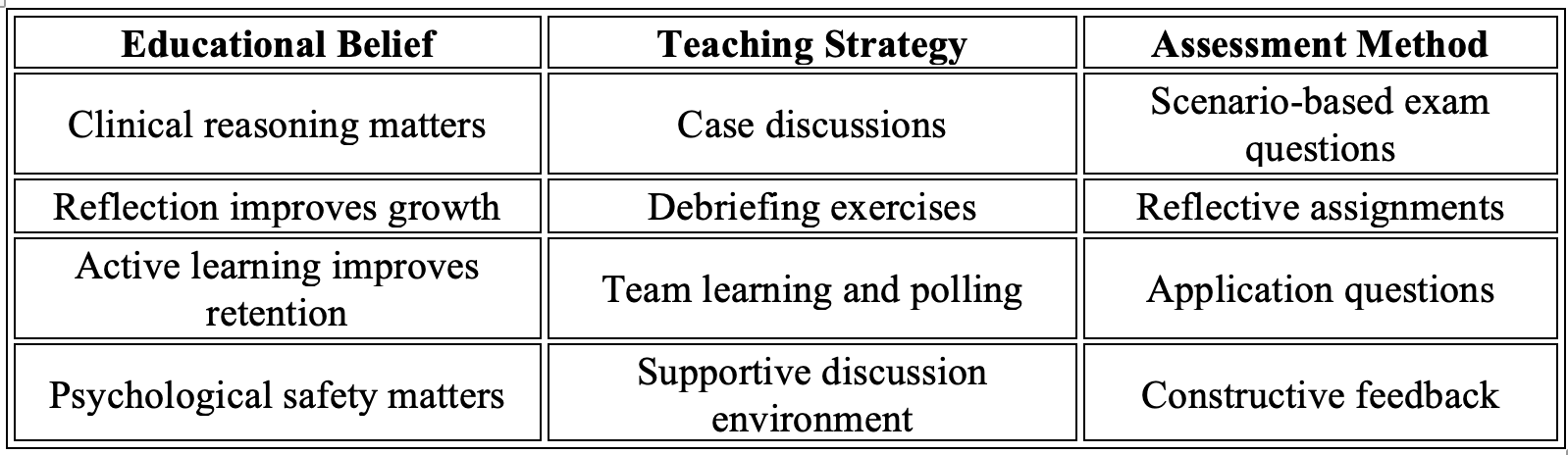
This alignment matters. Students quickly notice when educator behaviors conflict with stated values.
For example, saying “questions are encouraged” while responding negatively to student uncertainty can unintentionally discourage engagement.
Similarly, emphasizing critical thinking while assessing only memorization creates mixed messages. Consistency builds trust.
Incorporate Clinical and Didactic Teaching
One unique aspect of CRNA education is that teaching often happens in multiple environments.
Your teaching philosophy should account for both:
Didactic Teaching
In the classroom, educators often focus on:
Building foundational science
Clinical application
Concept integration
Preparation for NBCRNA examinations
Development of clinical reasoning
Didactic teaching should move beyond “covering content.”
Instead, consider asking:
How can I help students think like anesthesia professionals?
This may involve:
Clinical case integration
Decision-making frameworks
Polling and active participation
Concept mapping
Retrieval practice
Simulation videos
Clinical Teaching
Clinical education often focuses on:
Progressive autonomy
Real-time decision making
Technical skill refinement
Professional communication
Crisis management
Here, educators frequently shift into coaching and mentorship roles.
A strong philosophy recognizes that mistakes, uncertainty, and discomfort are often part of learning—provided patient safety remains protected.
The goal is not perfection during training.
The goal is progression toward competence.
Embrace Reflection and Growth as an Educator
Teaching philosophies should evolve.
Your beliefs about education may shift as you gain experience, encounter different learner needs, or better understand educational science.
Ask yourself regularly:
What teaching strategies have worked best?
Where do students struggle?
How do I respond to struggling learners?
Am I fostering independence or dependence?
Does my teaching align with my values?
Student evaluations, peer feedback, simulation outcomes, board performance, and self-reflection can all help refine your philosophy over time.
Great educators rarely stop developing.
Instead, they continuously improve their teaching just as they continuously improve clinical practice.
Writing Your Teaching Philosophy Statement
Eventually, many educators will need a formal teaching philosophy statement for:
Promotion and tenure
Faculty portfolios
Job applications
Leadership positions
Award nominations
A strong statement often includes:
Your Educational Purpose
What motivates you to teach?
Your Core Beliefs About Learning
How do students learn best in nurse anesthesia education?
Your Teaching Strategies
How do you operationalize those beliefs?
Assessment and Feedback
How do you evaluate and support learning?
Commitment to Growth
How do you continue improving as an educator?
Avoid generic language.
Instead of saying:
“I strive to create an engaging learning environment.”
Explain how you do it:
“I use case-based discussion, simulation debriefing, and formative questioning to encourage clinical reasoning and active engagement.”
Specificity strengthens credibility.
Final Thoughts
Developing a teaching philosophy is not about creating the perfect statement.
It is about becoming intentional in how you educate future CRNAs.
As nurse anesthesia educators, our influence extends far beyond lectures and clinical instruction. The habits, expectations, communication styles, and professional values we model often stay with students long after graduation.
When thoughtfully developed, a teaching philosophy provides clarity, consistency, and purpose.
It helps answer one of the most important questions in nurse anesthesia education:
What kind of anesthesia professional am I trying to help create?
The answer to that question often defines the educator you become.
Reflection Question
If your students described your teaching approach in three words, what would they say and would those words align with the educator you hope to be?